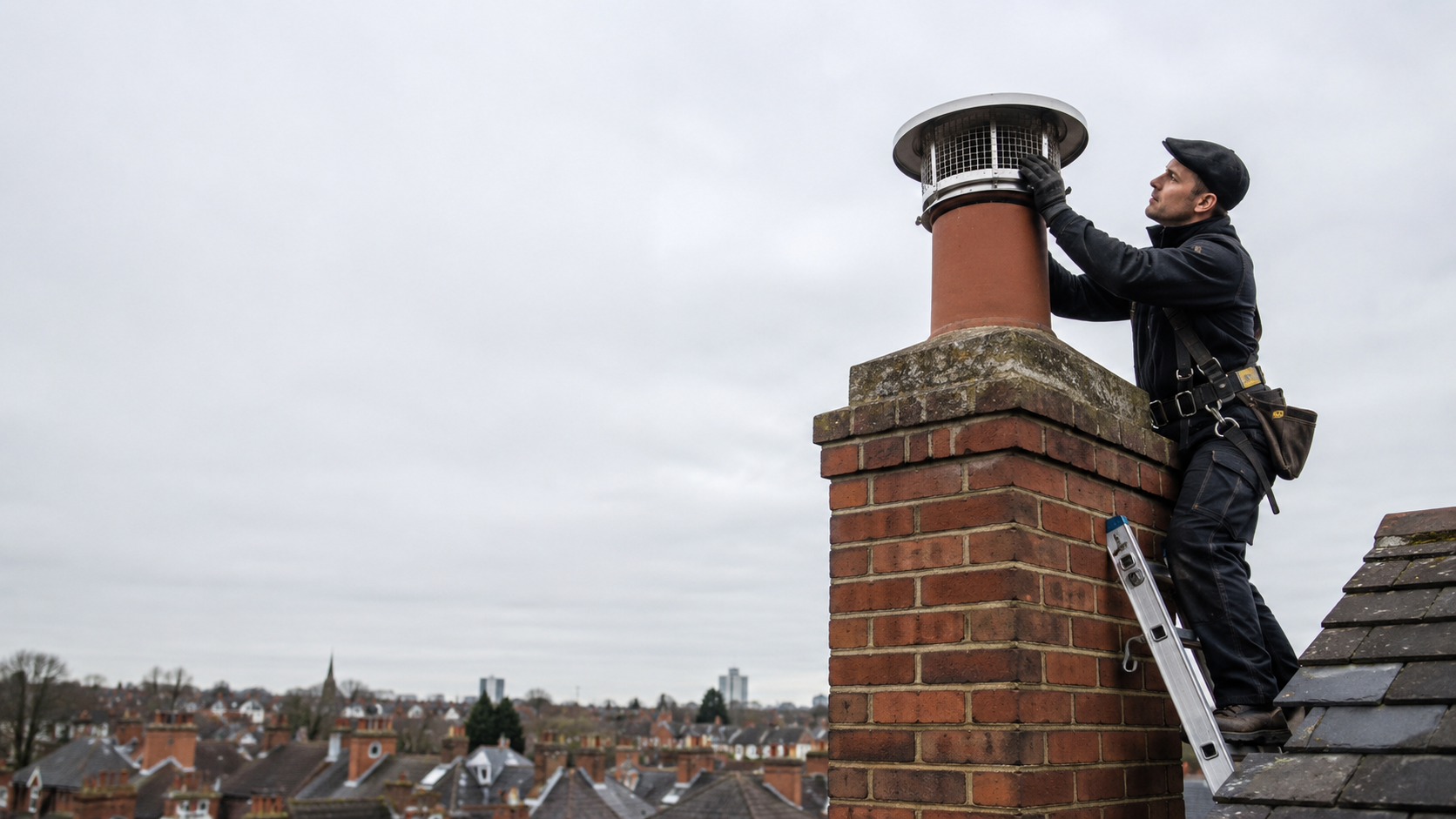
You do not automatically need a chimney cowl on every chimney, but fitting the right chimney cowl can solve or prevent several common problems.
A suitable cowl can help stop birds nesting inside your chimney, reduce rain entry, protect an unused flue or, in certain situations, help with downdraught.
However, choosing a chimney cowl is not simply a matter of buying one that fits your chimney pot.
Different fireplaces, log burners and heating appliances require different chimney terminals. Installing the wrong cowl can restrict the flue and interfere with the safe escape of combustion gases.
NACS specifically warns that chimney pots, cowls and terminals need to be compatible with the heating appliance below them. Some terminal covers are designed only for disused flues and must not be fitted to working gas, oil or solid-fuel chimneys.
So, do you need a chimney cowl?
The answer depends on your chimney, appliance and the problem you are trying to solve.
What Is a Chimney Cowl?
A chimney cowl is a fitting installed at the top of a chimney pot or flue terminal.
Depending on its design, it may help:
- Prevent birds entering the chimney
- Reduce rain entering the flue
- Prevent leaves and debris entering
- Address certain downdraught problems
- Protect a flexible flue liner
- Ventilate an unused chimney
- Provide the correct termination for a particular flue system
Cowls are available in many different materials and designs.
Common materials include:
- Stainless steel
- Galvanised steel
- Terracotta
- Aluminium
- Other specialist metals
The correct type should always be selected according to the fireplace, stove, fuel and flue system.
Industry guidance illustrates several different terminal designs, including bird guards, rain caps, anti-downdraught terminals and pot hangers for flexible liners.
Does Every Chimney Need a Cowl?
No.
Some properly designed working chimneys operate perfectly well with an open chimney pot and do not require an additional cowl.
A cowl should generally be fitted to solve a specific problem or meet the requirements of the particular chimney system.
For example, you may benefit from one if:
- Birds repeatedly enter your chimney
- You have previously had a bird nest
- Rain is entering the chimney
- Your flue liner requires a suitable terminal
- Downdraught has been professionally identified
- You are protecting and ventilating a disused chimney
Installing a cowl unnecessarily — particularly the wrong type — can sometimes create problems rather than solve them.
1. You May Need a Chimney Cowl to Stop Birds
Bird entry is one of the most common reasons homeowners consider installing a cowl.
Open chimney pots can provide attractive nesting locations, particularly when the fireplace is not regularly used.
Birds may carry large quantities of material into a chimney, including:
- Twigs
- Leaves
- Grass
- Moss
- Feathers
Eventually, this material can partially or completely block the flue.
NACS recommends seeking professional advice about a suitable terminal or guard when birds have entered a chimney.
A correctly selected chimney bird guard can significantly reduce the chance of birds entering and nesting again.
Signs You May Have Birds in Your Chimney
Watch for:
- Birds repeatedly landing on the chimney pot
- Birds disappearing inside the chimney
- Twigs falling into your fireplace
- Feathers in the hearth
- Scratching or fluttering noises
- Strong or unusual smells
- Suddenly poor chimney draught
If you suspect there is already a nest inside the chimney, do not simply install a cowl over it.
The chimney should first be professionally assessed and, once it is legal and appropriate to do so, the old nesting material should be removed and the flue swept.
Midlands Sweeps recommends fitting a suitable bird guard or chimney cowl after nest removal where appropriate to reduce the chance of the problem returning.
2. A Chimney Cowl Can Help Keep Rain Out
Another common reason for fitting a chimney cowl is rain.
Some chimneys are particularly exposed to driving rain because of:
- Their location
- Local weather
- Roof design
- Chimney-pot design
- Prevailing wind direction
A suitable rain cowl or rain cap can reduce the amount of water entering the chimney while still allowing combustion gases to escape.
This may be useful if you regularly notice:
- Water inside the fireplace
- Damp soot
- Moisture around the chimney
- Rusting stove or flue components
- Persistent damp chimney smells
However, water around a chimney breast does not automatically mean rain is entering through the chimney pot.
Damp can also result from:
- Damaged flashing
- Cracked masonry
- Failed pointing
- Damaged chimney crowns
- Condensation
- Roof defects
If the cause is uncertain, have the chimney inspected before assuming a rain cowl will solve the problem.
3. A Cowl May Help Prevent Future Bird Nests
If you have already paid to have a bird nest removed, you probably do not want the birds moving straight back in.
Once the chimney is clear and no active nest remains, a suitable bird guard can help prevent repeat nesting.
But the design matters.
The cowl needs to:
- Prevent bird access
- Remain appropriate for the fuel
- Allow adequate combustion-gas flow
- Avoid excessively restricting the chimney opening
- Remain accessible for maintenance
HETAS guidance notes that where a bird guard is required, an open-type mesh design may be appropriate in certain solid-fuel circumstances so that adequate flue draw is maintained.
4. You May Need an Anti-Downdraught Cowl
A fireplace that smokes into the room during certain weather conditions may sometimes be experiencing downdraught.
This occurs when pressure around the chimney causes air to travel downward through the flue rather than allowing combustion gases to rise normally.
Possible contributing factors include:
- Strong winds
- Nearby buildings
- Tall trees
- Roof design
- Chimney height
- Chimney position
- Local terrain
An anti-downdraught chimney cowl may help in certain situations.
However, you should not automatically install one because your fireplace smokes.
Smoke entering the room can also be caused by:
- A blocked chimney
- Heavy soot
- Bird nests
- Poor ventilation
- A cold chimney
- Fireplace dimensions
- Flue damage
The underlying cause needs to be identified first.
If your chimney only smokes during particular wind conditions, professional assessment can help determine whether an anti-downdraught terminal is appropriate.
5. A Flue Liner May Need a Suitable Cowl or Terminal
If you have a log burner connected to a flexible stainless steel flue liner, the top of that liner needs to terminate correctly.
Specialist fittings such as pot hangers and appropriate terminals can be used depending on the installation.
Industry guidance illustrates separate terminals for:
- Flexible twin-wall liners
- Bird protection
- Rain protection
- Anti-downdraught applications
The manufacturer’s installation instructions should always be followed when choosing the termination.
Midlands Sweeps includes cowl fitting where required as part of its log burner and flue installation work.
6. Unused Chimneys May Benefit From a Ventilated Cowl
A chimney that is permanently unused may benefit from protection against rain and birds.
However, completely sealing the chimney is generally not the objective.
An old chimney still needs ventilation.
Without airflow, moisture and condensation may build up inside the flue, potentially leading to:
- Damp chimney breasts
- Musty smells
- Staining
- Deteriorating masonry
- Condensation
NACS warns that closing a chimney containing soot can contribute to damp problems because wet soot can create acidic deposits that penetrate chimney walls.
Midlands Sweeps similarly advises that an unused chimney may benefit from a suitable ventilated cap or cowl rather than simply being completely sealed.
What Are the Different Types of Chimney Cowl?
There is no single “best chimney cowl” for every property.
The correct type depends on what you need it to do.
Bird Guard Chimney Cowl
A bird guard is designed primarily to prevent birds from entering the chimney.
It normally uses an open metal cage or mesh arrangement around the chimney opening.
Best suited for:
- Preventing bird entry
- Preventing repeat nesting
- Reducing larger debris entering the flue
A bird guard must still allow sufficient airflow.
Rain Cowl or Rain Cap
A rain cowl helps limit rain entering the chimney while maintaining a route for gases or ventilation.
Best suited for:
- Exposed chimney pots
- Rain-entry problems
- Appropriate working or unused flues, depending on design
The product must be compatible with the appliance.
Anti-Downdraught Cowl
This type is designed to help reduce wind-related downdraught.
Best suited for:
- Professionally diagnosed downdraught
- Chimneys affected by particular wind conditions
It should not be used as a universal cure for smoky fireplaces.
Bird and Rain Cowl
Some terminals combine both functions.
They provide a rain cover while incorporating a guard that prevents birds entering.
This can be useful where both problems are present.
Pot Hanger Cowl
A pot hanger is commonly associated with flexible stainless steel chimney liners.
It helps support or terminate the liner at the top of the chimney while providing an appropriate outlet.
Versions may incorporate:
- Bird protection
- Rain protection
- Anti-downdraught features
The specification must match the flue and appliance.
Cowl for an Unused Chimney
A disused chimney may use a ventilated terminal designed specifically for an inactive flue.
This is very important:
A terminal designed for a disused chimney should not automatically be used on a working fireplace or stove.
NACS warns that some termination covers are suitable only for unused chimneys and can dangerously restrict combustion gases if fitted to an active flue.
Can the Wrong Chimney Cowl Be Dangerous?
Yes.
This is arguably the most important thing to understand before buying a chimney cowl.
A working chimney needs to discharge combustion gases freely.
If the cowl or terminal reduces the flue opening too much, gases may not escape correctly.
Potential consequences include:
- Poor chimney draught
- Smoke entering the room
- Soot staining
- Appliance performance problems
- Carbon monoxide risk
NACS specifically warns about incorrect flue terminals being installed on working chimneys and states that some designs intended for disused flues can restrict the outlet and prevent combustion products from venting freely.
Therefore, do not choose a chimney cowl based only on:
- Price
- Appearance
- Chimney-pot diameter
- Online reviews
- The fact that it says “universal”
The cowl needs to be suitable for the actual heating appliance and flue system.
What Chimney Cowl Do I Need for a Log Burner?
A log burner requires a terminal suitable for solid-fuel combustion and compatible with the chimney or flue system.
The correct choice can depend on:
- Stove manufacturer requirements
- Flue diameter
- Flexible liner installation
- Existing chimney pot
- Chimney draught
- Bird protection requirements
- Weather exposure
Do not fit a terminal that restricts the flue diameter below what is required for the appliance.
Professional assessment is particularly worthwhile if the log burner has:
- Poor draught
- Repeated bird problems
- Rain entry
- A recently installed liner
- Smoke entering the room
Do I Need a Bird Guard on My Log Burner Chimney?
Not every log burner chimney needs one.
However, a bird guard may be useful when:
- Birds have previously nested inside the chimney
- The chimney pot is particularly accessible
- The appliance is unused for long periods
- Bird activity around the chimney is obvious
If a guard is installed, it must be compatible with solid-fuel use and should not unnecessarily restrict gas flow.
Do I Need a Chimney Cowl for an Open Fire?
Possibly, but not automatically.
An open fire with a correctly designed, well-performing chimney may function perfectly without one.
A cowl could be appropriate if you are dealing with a specific issue such as:
- Bird nesting
- Rain entry
- Confirmed wind-related downdraught
If your open fireplace is smoking into the room, have the chimney swept and inspected first.
A dirty or blocked chimney should not be “fixed” by simply fitting a different cowl.
Will a Chimney Cowl Stop Smoke Coming Into the Room?
Sometimes — but only when the problem is genuinely related to the chimney terminal or wind pressure.
Smoke entering your home can also result from:
- Soot buildup
- A bird nest
- Poor ventilation
- Creosote
- Incorrect fireplace dimensions
- A cold chimney
- Structural flue problems
Changing the cowl without diagnosing the cause could fail to solve the problem or even make chimney draught worse.
Will a Chimney Cowl Stop Rain Completely?
A properly selected rain cowl can significantly reduce direct rain entry, but it may not make a chimney completely moisture-free.
Some moisture can also come from condensation or building defects.
If you have persistent chimney damp, inspect:
- Flashing
- Pointing
- Chimney stack
- Chimney crown
- Roof junctions
- Internal ventilation
Do not assume every damp chimney simply needs a rain cap.
Do Chimney Cowls Need Cleaning?
Yes, they should be inspected as part of ongoing chimney maintenance.
A bird guard or mesh can potentially collect:
- Soot
- Tar
- Leaves
- Cobwebs
- Nesting material
- Other debris
Any significant restriction at the top of a working chimney can interfere with gas flow.
HETAS specifically warns in some contexts that fine terminal meshes or spark arrestors can become clogged and restrict combustion gases.
Regular chimney sweeping provides a good opportunity to check the terminal as well.
Should You Sweep the Chimney Before Installing a Cowl?
In many situations, yes.
If you are fitting a cowl because of bird activity or an unknown chimney condition, the flue should first be checked and cleared.
There is little benefit in protecting the top while leaving:
- An old bird nest
- Soot
- Creosote
- Fallen debris
inside the chimney.
NACS states that regular sweeping removes soot, bird nests, cobwebs and other obstructions so combustion gases have a clear route through the chimney.
After the chimney is clear, the appropriate terminal can be selected.
Should I Fit a Chimney Cowl Myself?
Chimney cowl installation generally involves roof access, which introduces significant fall risks.
There is also the technical question of selecting the correct terminal for your appliance.
A professional can assess:
- What fuel you burn
- The type of appliance
- Chimney-pot dimensions
- Existing liner
- Chimney draught
- Bird problems
- Rain exposure
- Whether the flue is active or disused
They can then recommend a terminal that does not compromise the chimney’s function.
NACS advises checking appliance and manufacturer instructions or consulting a professional chimney sweep when determining the correct chimney terminal.
Signs You Might Need a Chimney Cowl
Consider professional advice about a chimney cowl if you notice:
- Birds repeatedly entering the chimney
- A previous bird nest
- Twigs or feathers falling into the hearth
- Persistent rain entering through the chimney
- A flue liner requiring appropriate termination
- Fireplace problems specifically associated with wind
- An unused chimney requiring protection and ventilation
However, symptoms such as smoke entering the room should always be investigated rather than automatically blamed on the existing chimney pot.
Frequently Asked Questions
Is a chimney cowl necessary?
Not on every chimney. A suitable cowl can be useful for preventing birds, limiting rain, dealing with certain downdraught conditions or correctly terminating a liner.
What is the best chimney cowl?
There is no universally best cowl. The correct choice depends on your appliance, fuel, chimney and the problem you are trying to solve.
Does a chimney cowl stop birds?
A suitable bird guard can help prevent birds entering and nesting inside the chimney.
Can a chimney cowl stop rain?
A properly selected rain cowl can reduce direct rain entry while allowing the chimney to vent correctly.
Can a cowl improve chimney draught?
Certain anti-downdraught cowls may help with specific wind-related draught problems. However, poor draught can have many other causes and should be properly diagnosed first.
Can a chimney cowl make draught worse?
Yes. An unsuitable or restricted terminal can interfere with flue performance. This is why appliance compatibility is essential.
Can I put any chimney cowl on a log burner?
No. A working solid-fuel chimney needs a terminal suitable for the appliance and flue. Some products are designed only for disused chimneys.
Should I fit a cowl after removing a bird nest?
It can be a good preventative measure. Once the nest has been legally and safely removed and the chimney swept, a suitable bird guard can help prevent repeat nesting.
Does an unused chimney need a cowl?
A ventilated terminal may be helpful for preventing rain and bird entry while maintaining airflow. Avoid simply sealing the chimney completely without considering ventilation.
Does a chimney cowl need maintenance?
Yes. Cowls and bird guards should remain clear of soot, tar, leaves and other material that could restrict the flue.
So, Do You Need a Chimney Cowl?
A chimney cowl can be a very useful addition — when the correct type is fitted for the correct reason.
You may benefit from one if you want to:
- Prevent birds nesting
- Reduce rain entry
- Protect a chimney liner
- Address professionally diagnosed downdraught
- Protect and ventilate a disused chimney
But you should not simply fit whichever cowl fits the chimney pot.
The wrong chimney terminal can restrict combustion gases and interfere with fireplace or log burner performance. NACS advises that chimney cowls and terminals must be compatible with the heating appliance and flue beneath them.
Midlands Sweeps provides professional chimney services from Swadlincote and surrounding Midlands areas, including chimney sweeping, bird nest removal, log burner and flue liner installation, CCTV inspections, drone inspections and cowl fitting where required.
If you are unsure which chimney cowl you need, have the chimney assessed first so the correct solution can be selected for your fireplace, stove and flue.