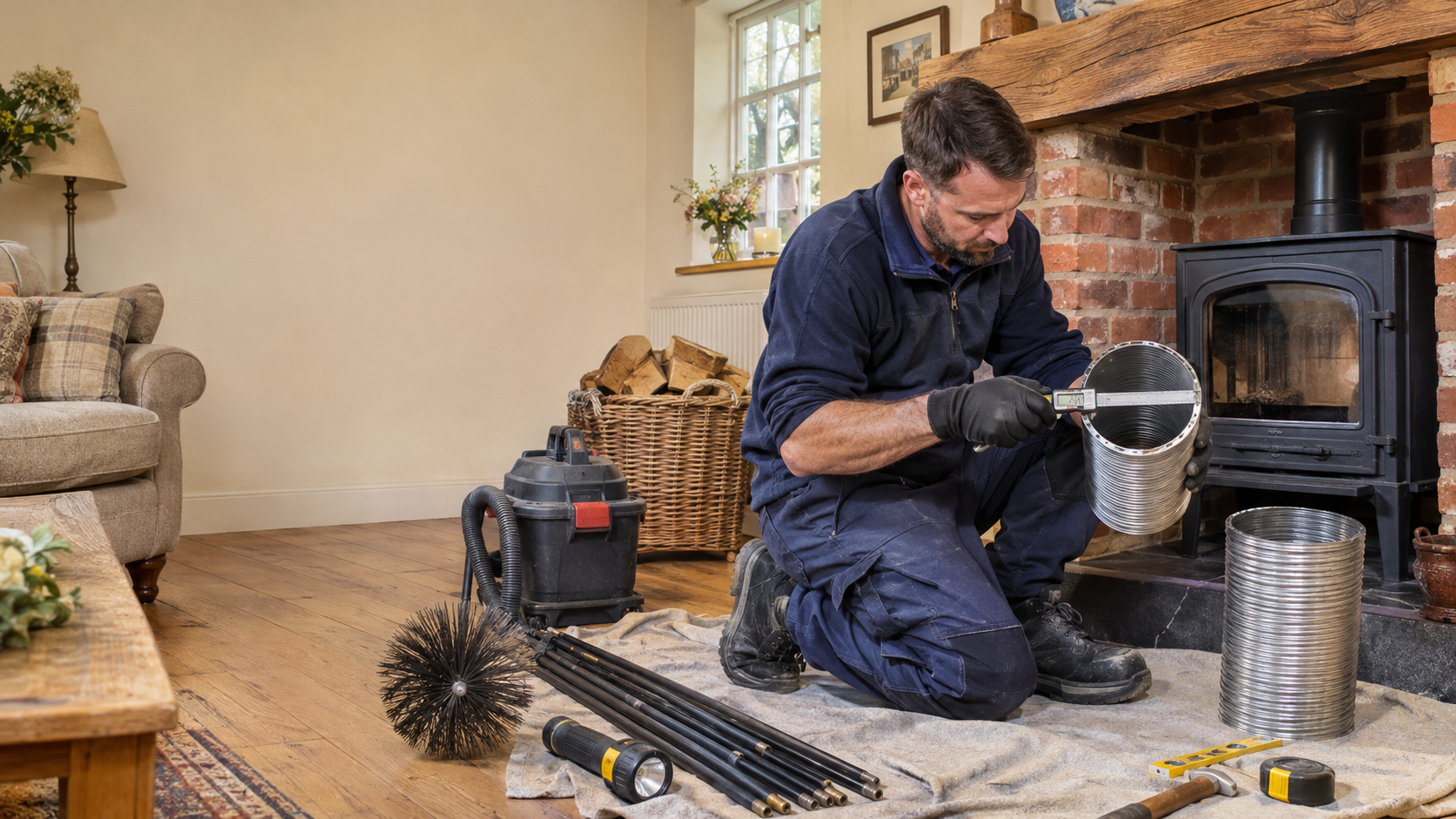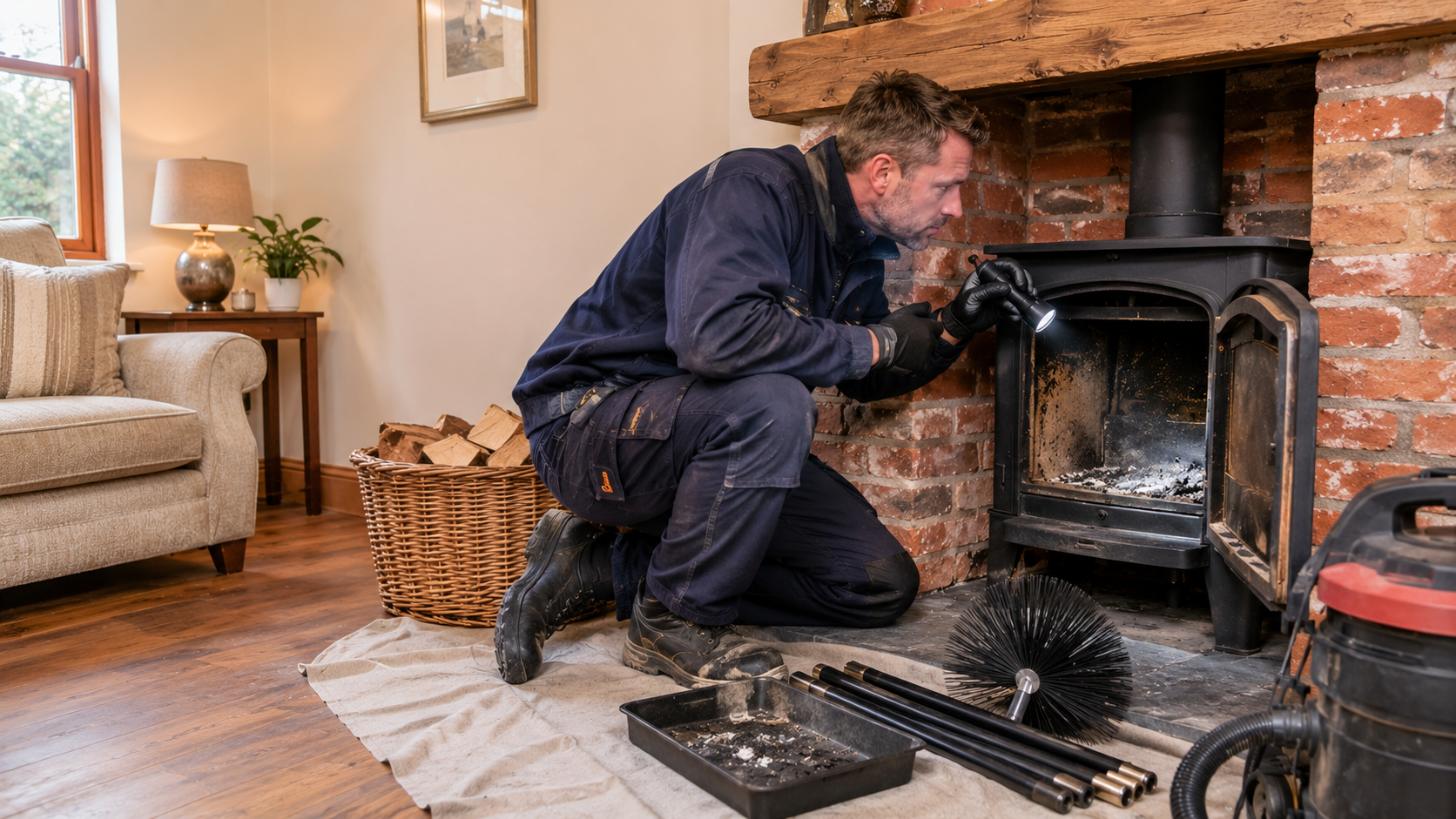
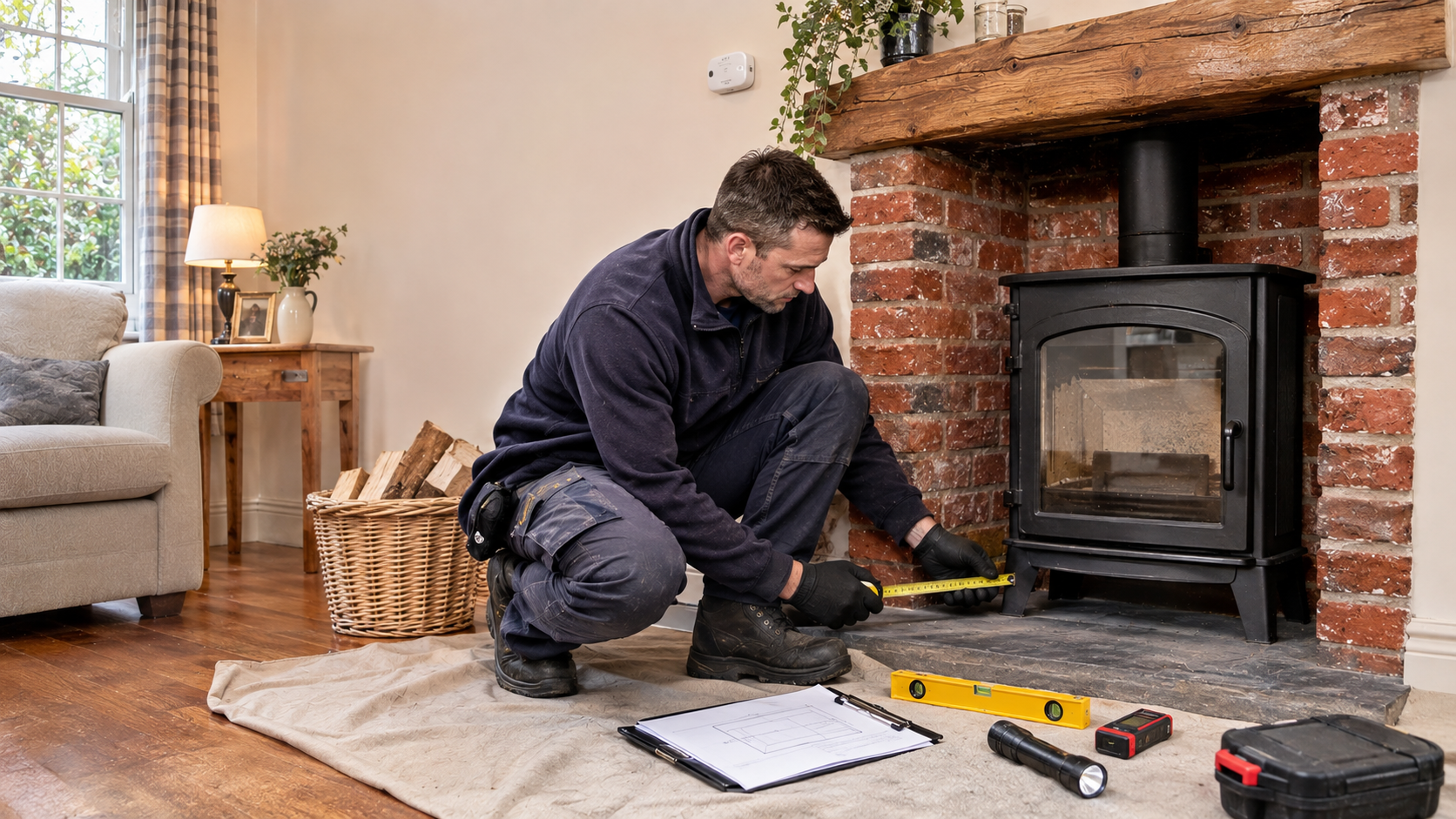
Installing a wood-burning stove can transform your living room, adding warmth, character and a practical source of home heating. However, before choosing your new appliance or arranging an installation, there is an important question many homeowners overlook.
Do you need Building Regulations approval for a log burner in England?
The short answer is yes. Installing a new log burner is normally classed as notifiable building work, which means the installation must meet the relevant Building Regulations and be properly certified or approved.
This applies whether you are installing a modern wood-burning stove into an existing fireplace or creating a new flue system for a property without a traditional chimney.
Fortunately, the process does not always require you to submit an application directly to the council.
In this guide, Midlands Sweeps explains how log burner Building Regulations work in England, what HETAS certification means, when building control approval is necessary and what homeowners should check before installation.
Why Do Log Burner Installations Need Building Regulations Approval?
Wood-burning stoves produce significant heat and combustion gases, so their installation needs to meet established safety requirements.
An incorrectly installed appliance can create problems such as:
- Smoke entering the living room.
- Carbon monoxide escaping into the property.
- Heat damage to surrounding building materials.
- Inadequate combustion ventilation.
- Poor chimney draught.
- Chimney fires caused by unsuitable flue arrangements.
- Unsafe clearances around combustible materials.
Building Regulations are designed to reduce these risks by establishing minimum standards for installing heating appliances and associated chimney systems.
Even if your stove appears to work correctly, that does not automatically mean the installation meets legal requirements.
What Is Approved Document J?
In England, one of the most important documents relating to log burner installation is Approved Document J, which provides guidance on meeting Building Regulations for combustion appliances and fuel storage systems.
It covers essential considerations including:
- Combustion air supply and ventilation.
- Safe discharge of smoke and combustion gases.
- Chimney and flue construction.
- Hearths and protection from heat.
- Clearance from combustible materials.
- Carbon monoxide alarms.
- Installation information and notice plates.
For example, a wood-burning stove must have a suitable flue system to remove combustion gases safely.
The hearth must also provide appropriate protection for the floor and surrounding materials.
Approved Document J provides practical guidance on ways to meet the legal requirements, although other compliant solutions may be possible where properly demonstrated.
Homeowners can read the official guidance on the UK Government’s Approved Document J page.
Do You Need Council Approval If You Use a HETAS Installer?
This is one of the most common questions homeowners ask when planning a log burner installation.
In many cases, you do not need to apply to building control yourself when using an installer registered with an appropriate competent person scheme.
HETAS operates a recognised competent person scheme for solid-fuel heating installations.
A HETAS registered installer who is authorised for the relevant category of work can self-certify an installation they have carried out.
The installer can then notify the appropriate local authority through the scheme.
This generally means the homeowner does not need to arrange a separate building control inspection for that work.
However, it is important to check that your installer is currently registered for the specific installation work being undertaken.
Professional chimney sweeping qualifications or membership of a chimney sweeping association do not automatically provide authority to self-certify new stove installations.
You can check registration details through the official HETAS installer directory.
What Happens If Your Installer Is Not HETAS Registered?
Using a HETAS installer is not the only route to a compliant installation.
If your chosen installer is not registered with an appropriate competent person scheme, the installation can still proceed through the relevant building control process.
However, an application must generally be made before the work begins.
This normally involves contacting your local authority building control department or an appropriate registered building control approver.
The building control body can explain the application, inspection and certification requirements.
Depending on the work, inspections may be needed during installation and after completion.
Fees will usually apply.
You should not assume that a HETAS installer can simply visit afterwards and issue a certificate for an installation completed by someone else.
HETAS registered installers can only self-certify work they have personally carried out under their relevant registration.
HETAS Certification vs Building Control Approval
Both routes can provide the required compliance documentation, but the process is different.
| Feature | Competent person scheme | Building control route |
|---|---|---|
| Who arranges compliance notification? | Registered installer | Applicant and building control body |
| Application before work? | Normally no separate homeowner application | Generally required |
| Compliance assessment | Authorised installer self-certifies | Building control assessment and inspections |
| Fees | Generally incorporated into installation arrangements | Building control charges usually apply |
| Final evidence | Certificate of Compliance | Appropriate building control completion documentation |
The important thing is ensuring that the work is properly assessed, notified and documented through the correct route.
What Are the Main Building Regulations for Installing a Log Burner?
Although every property is different, several important requirements should be considered before installation.
1. Suitable Chimney and Flue System
A wood-burning stove must connect to a suitable chimney or flue that can safely carry combustion gases outside.
The flue must be appropriate for the appliance, fuel and operating temperatures.
If you have an existing masonry chimney, its condition should be checked before connecting a stove.
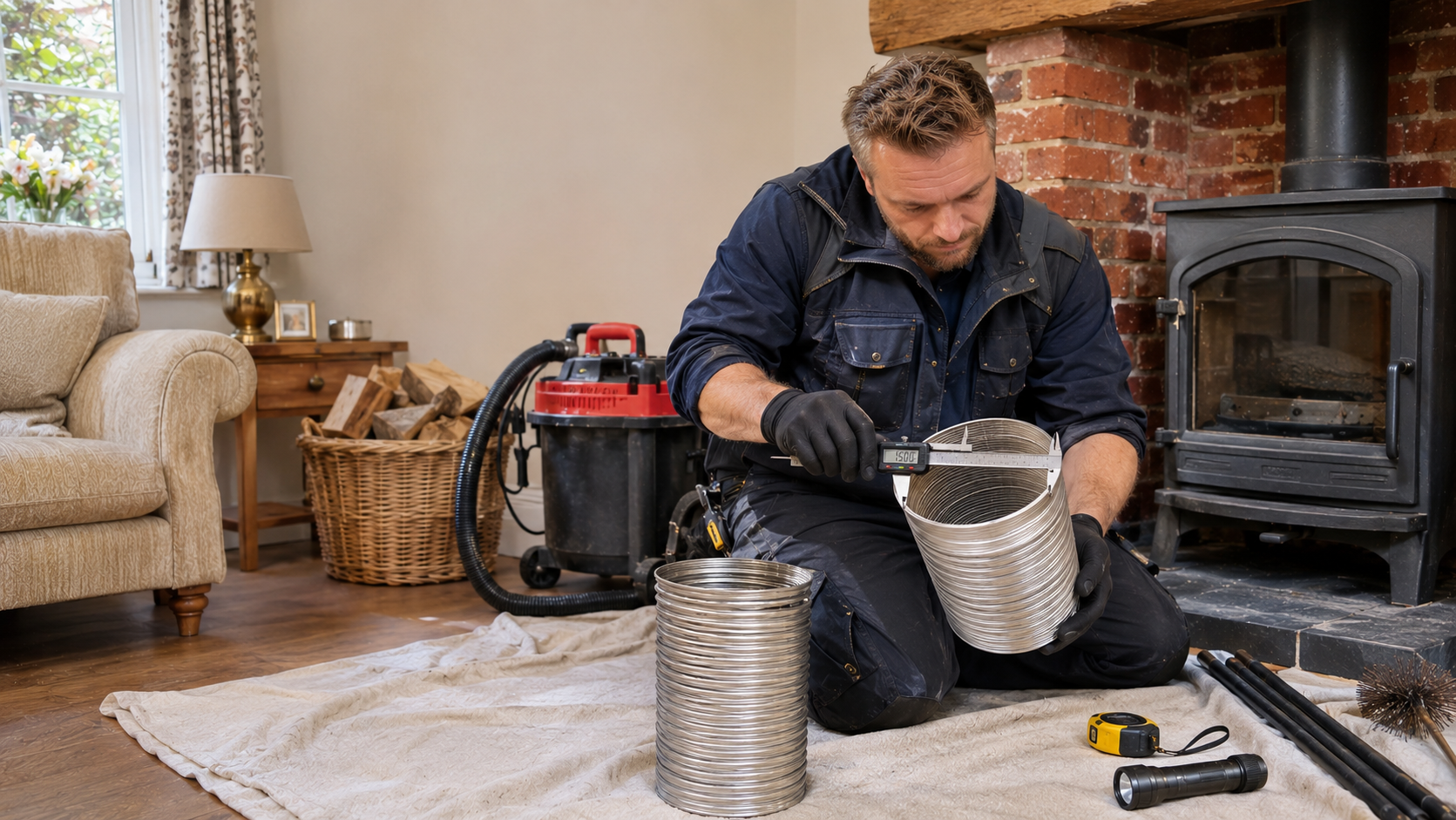
Some installations may require a stainless-steel flue liner, while others may be suitable without relining.
The correct flue diameter, height, construction and condition all matter.
Where a property does not have a traditional chimney, a suitable factory-manufactured chimney system may be an option.
2. Appropriate Hearth Protection
A log burner must be installed on a hearth suitable for the appliance and surrounding building construction.
The hearth helps protect combustible floors and nearby materials from heat.
Required dimensions and construction depend on the appliance design and relevant installation conditions.
Some modern stoves are approved for particular hearth arrangements, while others require more substantial protection.
An installer should confirm the necessary specification before work begins.
3. Adequate Combustion Ventilation
Wood-burning stoves need a sufficient supply of air to burn fuel correctly.
If a property is particularly airtight or the appliance has a higher heat output, additional permanent ventilation may be required.
However, it is incorrect to assume that every stove rated at 5kW or less automatically needs no ventilation.
The requirements depend on the appliance, property characteristics and applicable regulations.
Ventilation must be assessed during installation rather than guessed.
4. Safe Distances From Combustible Materials
Wood-burning stoves and flue pipes can become extremely hot.
The installation must maintain appropriate clearances from combustible materials such as timber beams, furniture, flooring and certain wall finishes.
These distances depend on the specific appliance, flue components and surrounding construction.
Always follow the manufacturer’s installation instructions and applicable Building Regulations.
5. Carbon Monoxide Alarm Installation
A suitable carbon monoxide alarm is required when installing a new or replacement fixed solid-fuel appliance in a dwelling in England.
The alarm must be correctly positioned and installed according to applicable requirements and manufacturer guidance.
Carbon monoxide is a colourless, odourless gas that can be produced during incomplete combustion.
An appropriate alarm provides an important warning if dangerous concentrations develop, but it does not replace correct installation and maintenance.
6. Installation Testing and Documentation
Once the work is completed, the appliance and flue system must undergo appropriate commissioning checks.
These may include checks of chimney performance, combustion air, flue integrity and other relevant installation conditions.
The installer should also provide the necessary documentation and explain correct appliance operation.
Do You Need Planning Permission for a Log Burner?
Building Regulations approval and planning permission are different requirements.
Installing a log burner inside an existing fireplace will not normally require planning permission if the work involves no external changes or other development requiring consent.
However, planning considerations can become more complicated when adding a new external flue or modifying the chimney.
Planning permission or additional consent may be necessary if:
- The property is listed.
- The building is within a conservation area or another designated location.
- The installation requires an external flue that does not meet permitted development conditions.
- Significant changes are proposed to the chimney or building exterior.
- The property is a flat or another building where ordinary householder permitted development rights do not apply.
For period properties in areas such as Ashby-de-la-Zouch, Derby and Burton on Trent, checking local planning requirements before altering an original chimney is particularly worthwhile.
Contact your local planning authority if you are unsure whether consent is required.
What About Smoke Control Areas?
Another important consideration is whether your property is located within a designated Smoke Control Area.
These areas are subject to additional restrictions intended to reduce smoke pollution.
If you want to burn wood in a Smoke Control Area, you generally need an appliance that is exempt for that purpose, commonly described as a DEFRA-exempt stove.
The appliance must be operated using the fuels permitted for that model and in accordance with its instructions.
Not every home is located within a Smoke Control Area, and the restrictions can vary by location.
Before buying a stove, check with your local council or consult the UK Government’s smoke control guidance.
A stove’s compliance with smoke control rules is separate from the Building Regulations requirements for its installation.
Can You Install a Log Burner Yourself in England?
It is possible to arrange a log burner installation without employing a HETAS registered installer.
However, the work must still comply with Building Regulations and follow the appropriate building control process.
An application normally needs to be submitted before installation begins.
You will also need to ensure that the appliance, chimney, ventilation, hearth and surrounding construction meet the required standards.
Because solid-fuel installations involve fire and combustion-gas risks, professional installation is strongly recommended.
DIY work should never be undertaken without the necessary technical competence and building control arrangements.
A log burner that appears to function normally is not proof of a compliant or safe installation.
What Certificates Should You Receive After Installation?
After a compliant installation, homeowners should receive appropriate documentation confirming the work has been completed through the required regulatory route.
Depending on how the installation was carried out, this may include:
- A competent person scheme Certificate of Compliance or the relevant building control completion documentation.
- Appliance manufacturer’s instructions.
- Commissioning and testing records.
- Details of the installed appliance and flue system.
- The required chimney or hearth notice plate.
- Relevant warranty and maintenance information.
Keep these documents somewhere safe.
They may be important when arranging future maintenance, discussing the installation with your insurer or selling the property.
A chimney sweeping certificate is not the same as a Building Regulations Certificate of Compliance for a stove installation.
What If Your Existing Log Burner Has No Certificate?
Homeowners sometimes discover that a stove installed by a previous owner has no associated Building Regulations paperwork.
This does not automatically prove that the stove was installed incorrectly.
However, it may create difficulties when selling the property or demonstrating that the original work was properly notified.
If you cannot locate the certificate, check with the installer, relevant competent person scheme or local authority building control department.
Depending on the age and circumstances of the installation, records may be available.
If the work was never notified, your building control body can advise on possible next steps, including whether a regularisation process is available.
Do not assume that a routine chimney sweep can retrospectively certify an existing stove installation.
If the appliance’s safety or installation history is uncertain, arrange an appropriate professional assessment before using it.
Why Professional Installation Matters for Homeowners in Derbyshire and Staffordshire
Homes across Derbyshire, Staffordshire and surrounding areas include traditional terraced houses, period cottages, modern developments and properties without existing chimney systems.
Each can present different installation requirements.
For example, an older property may need a chimney inspection or flue liner before a new stove is fitted.
A modern property may require careful ventilation assessment and a suitable manufactured flue system.
Professional installation helps identify these requirements before work begins, reducing the likelihood of unexpected alterations or compliance problems.
Midlands Sweeps provides log burner installation, flue liner installation and chimney preparation services across Swadlincote, Burton on Trent, Derby, Ashby-de-la-Zouch and surrounding areas.
Frequently Asked Questions About Log Burner Building Regulations
Do all log burners need Building Regulations approval in England?
New installations of fixed wood-burning and other solid-fuel appliances are normally notifiable building work. The installation must meet the applicable Building Regulations and be certified through an appropriate competent person scheme or the building control process.
Is it illegal to install a log burner without HETAS?
No. HETAS registration is not the only legal route. However, if the work is not self-certified by an appropriately registered competent person, building control approval and notification arrangements are generally required.
Can I install a log burner into an existing fireplace without approval?
No. Using an existing fireplace does not automatically remove the requirement for Building Regulations compliance and notification when installing a new stove.
Do I need planning permission for a log burner in England?
Not normally for a straightforward internal installation, but external flues, listed properties and certain designated areas can require additional permission or consent.
Is a 5kW log burner exempt from Building Regulations?
No. A stove’s 5kW heat output does not exempt it from Building Regulations. Ventilation and flue requirements still need to be assessed.
Can a chimney sweep issue a HETAS certificate?
Being a professional chimney sweep does not automatically authorise someone to self-certify log burner installations. The installer must hold the appropriate competent person scheme registration for the work performed.
What happens if I sell a house without a log burner certificate?
Missing compliance documentation can raise questions during conveyancing. Your solicitor may request further information, and the appropriate building control body or scheme operator may be able to help locate records or explain available options.
Does replacing an old wood burner require notification?
Replacing a fixed solid-fuel appliance is normally notifiable work, even when an existing chimney is used. The new appliance and associated installation must comply with the relevant requirements.
Book Professional Log Burner Installation With Midlands Sweeps
Understanding log burner Building Regulations in England is an important part of planning a wood-burning stove installation.
From chimney construction and flue liners to ventilation, hearth protection and compliance documentation, several details must be considered before the appliance is ready for use.
At Midlands Sweeps, we provide professional wood-burning stove installation, chimney sweeping, flue liner installation and related chimney services across Swadlincote, Burton on Trent, Derby, Ashby-de-la-Zouch, Coalville and surrounding areas.
As a veteran-owned, fully insured business and registered member of the National Association of Chimney Sweeps, we focus on professional workmanship and careful attention to chimney safety.
Whether you’re installing your first log burner or replacing an older appliance, contact us to discuss your property, chimney requirements and how the necessary compliance and notification arrangements will be handled.
Planning a new log burner installation? Contact Midlands Sweeps today.
Phone: +44 782 483 0604
Email: midlandsweeps@gmail.com
Website: https://midlandsweeps.com/
Log Burner Installation: https://midlandsweeps.com/services/log-burner-installation/
Book an Appointment: https://midlandsweeps.com/contact-us/
Midlands Sweeps — professional log burner installation and chimney services for homes across the Midlands.