
Choosing a wood-burning stove is an exciting home improvement project. A log burner can become a beautiful focal point in your living room, provide comfortable warmth during colder months and add character to both traditional and modern interiors.
However, one of the most important decisions isn’t necessarily the style or appearance of the stove. It’s choosing the correct heat output for your room.
A log burner that’s too small may struggle to keep your living space comfortable. On the other hand, an oversized stove can produce excessive heat, encouraging you to restrict airflow and operate it inefficiently.
If you’re wondering what size log burner you need for your living room, understanding kilowatt ratings, room dimensions and insulation can help you make a better decision.
In this guide, Midlands Sweeps explains how wood burner sizing works, how to estimate your heating requirements and what to consider before arranging a professional log burner installation.
Why Choosing the Right Log Burner Size Matters
Wood-burning stoves come in different sizes and heating capacities, commonly ranging from small 3kW models to larger appliances capable of producing significantly more heat.
However, bigger doesn’t always mean better.
The correct stove should provide enough warmth for the room without regularly making the space uncomfortably hot.
Choosing an appropriately sized stove can help:
- Maintain a comfortable living room temperature.
- Reduce the temptation to operate the fire inefficiently.
- Support cleaner combustion when the appliance is used correctly.
- Avoid unnecessarily high fuel consumption.
- Improve the overall experience of using your stove.
- Make better use of the available fireplace and living room space.
A correctly sized log burner should complement your home’s heating requirements rather than overpower them.
Understanding Log Burner Heat Output: What Does kW Mean?
When comparing wood-burning stoves, you’ll notice that manufacturers describe their heat output in kilowatts, abbreviated as kW.
A kilowatt is a unit of power that indicates the rate at which heat is produced.
For example, a stove rated at 5kW has a higher nominal heat output than a stove rated at 3kW.
However, this doesn’t mean a 5kW stove continuously produces exactly 5kW whenever it’s burning.
Actual heat output varies depending on the fuel, the stage of combustion and how the appliance is operated.
The nominal heat output is the manufacturer’s rated output under specified test conditions. This is an important figure to consider when comparing appliances.
For many typical British living rooms, relatively modest stove outputs may be sufficient, particularly where the property has good insulation.
How to Calculate What Size Log Burner You Need
A commonly used starting point for estimating wood-burning stove heat output is based on the volume of the room.
This basic method can help you understand approximately how much heat your living space might require.
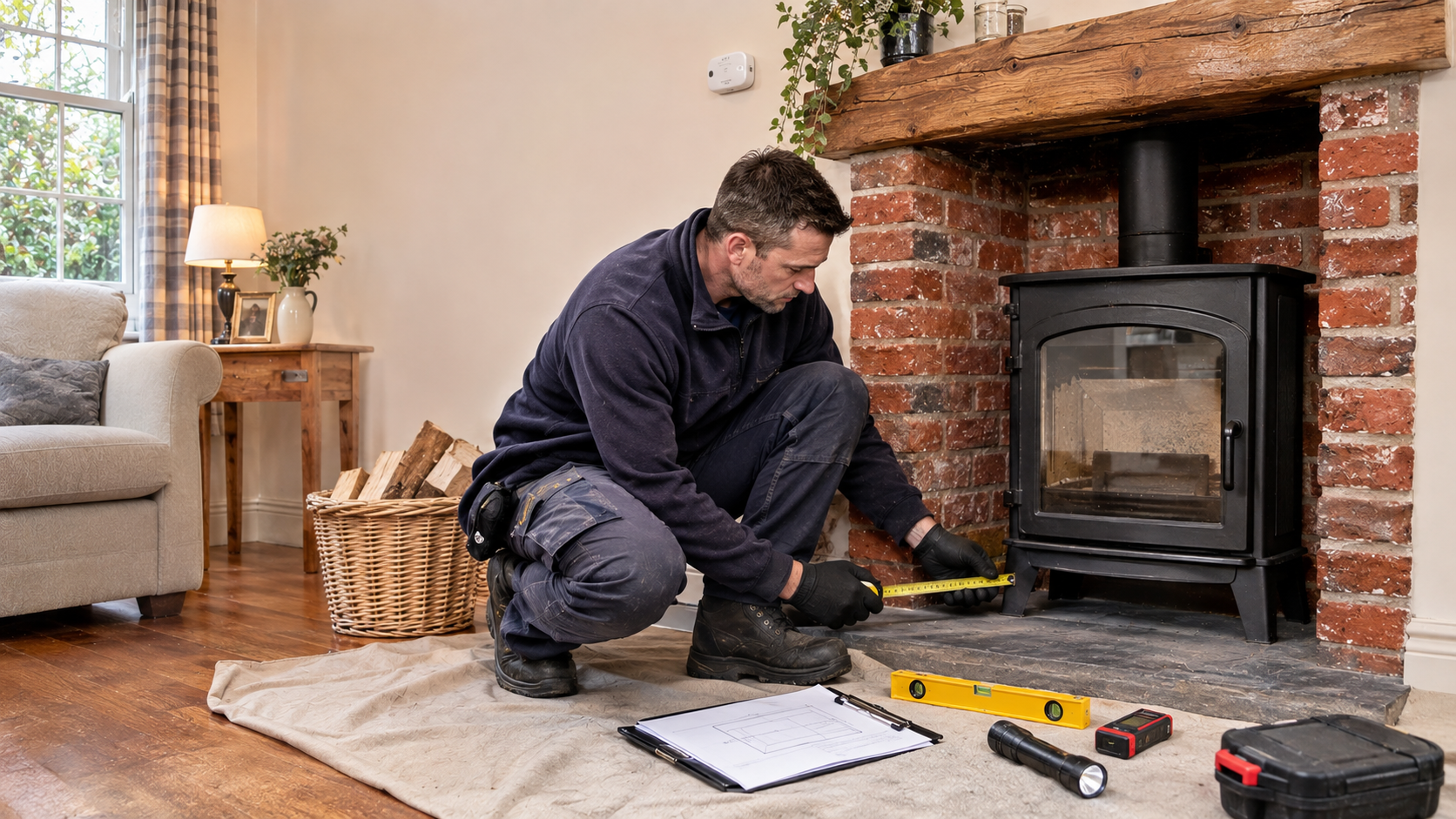
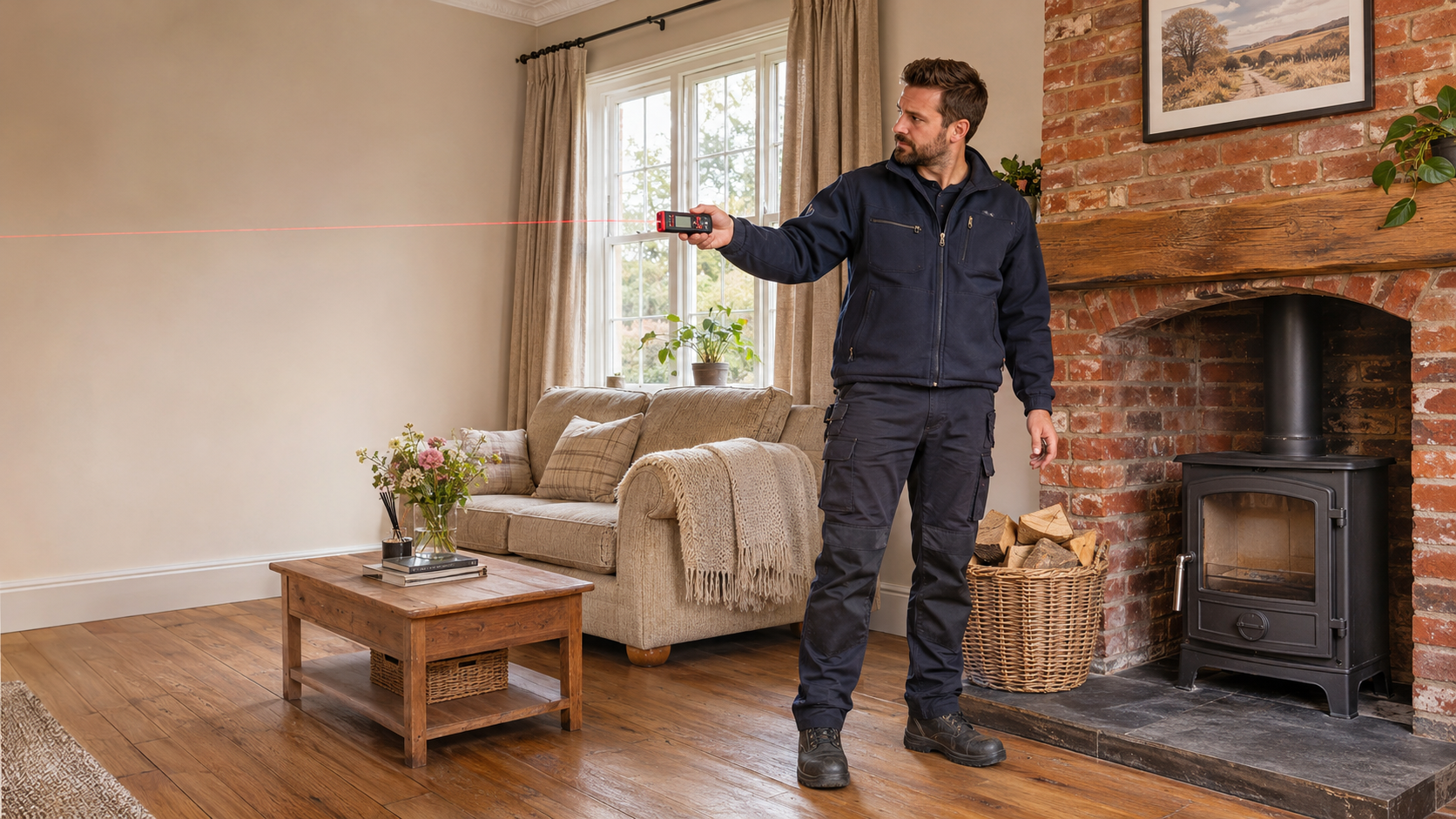
Step 1: Measure Your Living Room
Measure your room’s:
- Length in metres.
- Width in metres.
- Ceiling height in metres.
Multiply these measurements to calculate the room’s volume in cubic metres.
Step 2: Calculate the Room Volume
For example, imagine your living room measures:
- Length: 5 metres.
- Width: 4 metres.
- Ceiling height: 2.5 metres.
Your calculation would be:
5 × 4 × 2.5 = 50 cubic metres (m³)
Step 3: Estimate the Required Heat Output
For a room with average insulation, a commonly used rule of thumb is:
Room volume (m³) ÷ 14 = Approximate stove output (kW)
Using the example above:
50 ÷ 14 = 3.6kW
This suggests a stove with a nominal output of around 3.5–4kW could be worth considering.
However, this is only a preliminary estimate.
Actual heating requirements depend on insulation, heat loss, windows, outside walls and other characteristics of the property.
A professional heat-loss assessment is recommended before choosing your final stove size.
Log Burner Size Guide for Different Living Rooms
The following table provides illustrative calculations based on average insulation and the simple room-volume formula.
| Living room dimensions | Room volume | Approximate heat output |
|---|---|---|
| 3m × 3m × 2.4m | 21.6m³ | 1.5kW |
| 4m × 4m × 2.4m | 38.4m³ | 2.7kW |
| 5m × 4m × 2.5m | 50m³ | 3.6kW |
| 6m × 5m × 2.5m | 75m³ | 5.4kW |
| 7m × 5m × 2.5m | 87.5m³ | 6.3kW |
These figures are rough estimates, not guaranteed stove recommendations. Actual appliance selection should be based on the property’s heat loss and installation requirements.
A modern, well-insulated living room may need considerably less heat than an older property of identical dimensions.
This is why room measurements alone cannot determine the correct stove.
1. Consider How Well Your Home Is Insulated
Insulation is one of the biggest factors influencing log burner sizing.
A well-insulated room retains warmth more effectively, reducing the amount of heat required to maintain a comfortable temperature.
For example, a modern home with insulated walls, double glazing and limited draughts may require a relatively small stove.
An older Victorian or Edwardian property with solid walls, draughty windows and limited insulation may lose heat much faster.
Other factors include the number of outside walls, loft insulation, floor construction and the presence of large windows.
For homeowners in Swadlincote, Derby, Burton on Trent and surrounding areas, the age and construction of the property should be considered alongside the room’s dimensions.
A professional installer can assess these factors and recommend a suitable heating output.
2. Is a 5kW Log Burner Enough for Your Living Room?
A 5kW log burner is a common choice among UK homeowners because it sits within the middle of the output range offered by many domestic stove manufacturers.
For a moderately sized living room with average insulation, a stove of this capacity may be suitable.
However, a 5kW stove is not automatically the best choice for every property.
In a small, well-insulated room, it could produce more heat than needed.
In a large, poorly insulated space, it may not provide sufficient warmth.
The correct decision should be based on the heat requirement of the room rather than choosing a particular rating simply because it’s popular.
A useful rule: Select a stove for the heat your room actually needs, not the maximum output you can fit into the fireplace.
3. What Happens If Your Log Burner Is Too Big?
An oversized wood-burning stove can cause several problems.
If the stove produces excessive heat, you may find yourself opening windows or reducing the air supply to lower the room temperature.
Running the stove with insufficient combustion air can encourage smouldering and incomplete combustion.
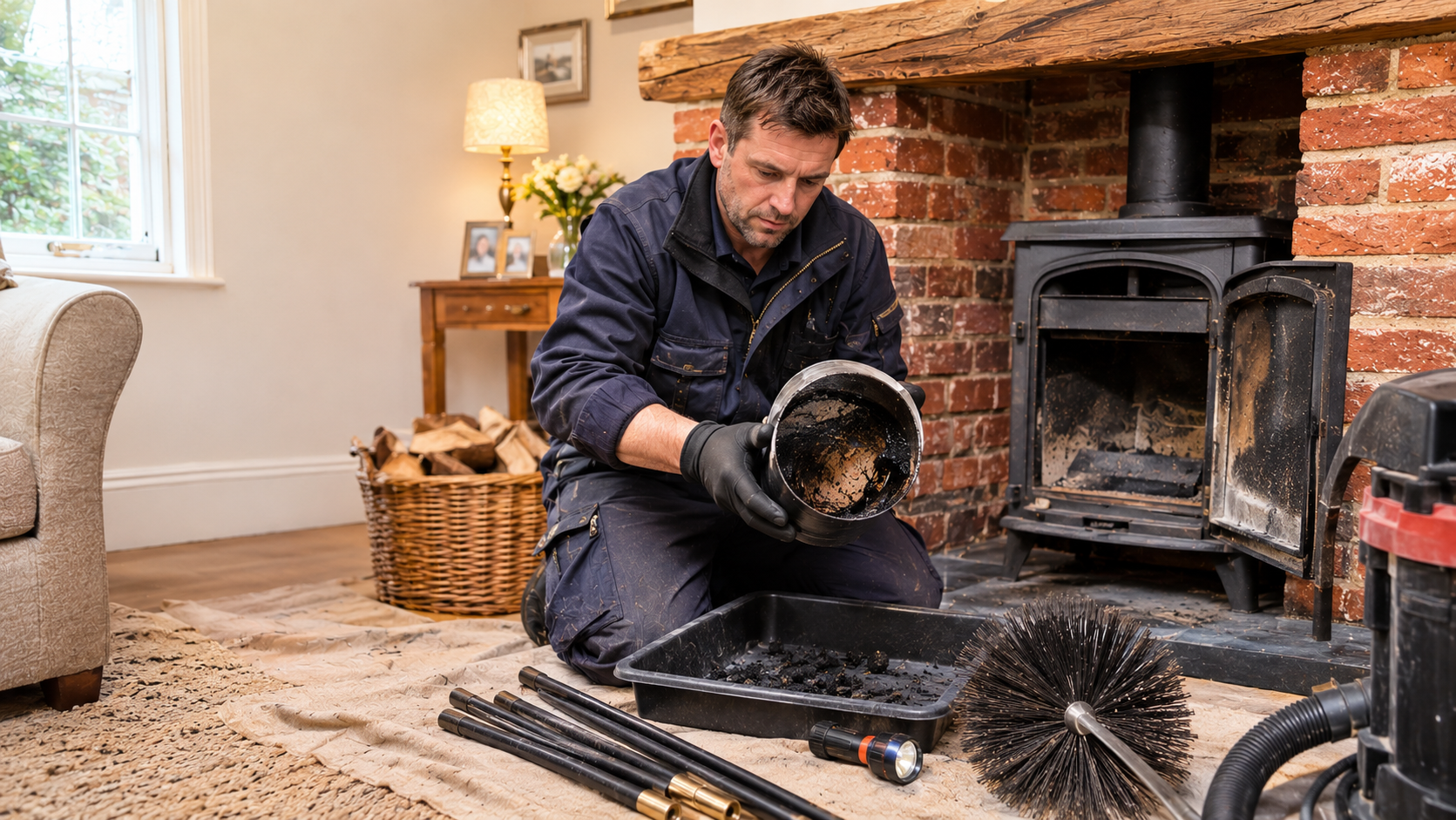
This may increase smoke, soot and tar-like deposits inside the appliance and chimney.
It can also contribute to the glass turning black more quickly.
Choosing an oversized appliance may therefore reduce comfort while making efficient operation more difficult.
If you regularly have to restrict airflow to keep a room tolerable, the appliance may not be well matched to the space.
4. What Happens If Your Log Burner Is Too Small?
An undersized stove can create a different set of problems.
If it cannot provide enough heat for the room, you may struggle to maintain a comfortable temperature during colder weather.
Homeowners may be tempted to load the stove heavily or operate it beyond the manufacturer’s recommended conditions.
This can place unnecessary stress on appliance components and increase the risk of overheating.
A small stove may still be suitable when used as supplementary heating, rather than as the room’s primary heat source.
The important thing is understanding how much warmth you expect the appliance to provide.
5. Does an Open-Plan Living Room Need a Bigger Stove?
Open-plan living areas require particular attention when choosing a log burner.
A stove installed in a living room that opens directly into a dining area or kitchen may need to heat a greater volume of air than one installed in an enclosed lounge.
However, simply adding together every room’s dimensions isn’t always sufficient.
Heat distribution, ceiling height, insulation, doorways and the position of the appliance all affect how warmth moves through the property.
An open-plan space with extensive glazing may have different heating needs from an enclosed room of similar floor area.
For these installations, a professional heat-loss calculation is especially valuable.
6. Will a Log Burner Heat the Entire House?
Some homeowners hope that installing a powerful wood burner in their living room will provide warmth throughout the property.
Although heat can travel into adjoining areas, a standard room-heating stove is primarily designed to heat the space where it’s installed.
How effectively warmth reaches other rooms depends on the layout, airflow, insulation and heating requirements of the property.
Installing an unnecessarily large stove to heat distant rooms can result in the living room becoming excessively hot while other areas remain relatively cool.
If you’re planning to use a log burner as part of a whole-house heating strategy, seek specialist advice on the appropriate heating system and heat distribution.
7. Consider the Physical Size of Your Fireplace
Heat output isn’t the only measurement that matters.
The physical dimensions of the stove must also be suitable for the intended installation.
When fitting a wood burner into an existing fireplace, the installer needs to consider:
- The width and depth of the fireplace opening.
- The stove manufacturer’s required clearances.
- The hearth dimensions and construction.
- The location of combustible materials.
- The position and suitability of the flue connection.
- Access for cleaning, inspection and maintenance.
A stove may fit visually within the fireplace opening but still be unsuitable because of inadequate clearances or other installation requirements.
Never assume that a stove can be installed safely simply because its external dimensions fit the available space.
8. Do You Need Extra Ventilation for a Larger Log Burner?
Wood-burning stoves require a suitable supply of combustion air.
In England, Approved Document J provides guidance covering ventilation, chimneys, flues and other safety requirements for solid-fuel appliances.
Ventilation requirements depend on several factors, including appliance output, design and the airtightness of the property.
For example, a stove rated at 5kW or less is not automatically exempt from ventilation requirements.
Modern airtight homes may require dedicated combustion-air provision even for relatively small appliances.
An installer should assess ventilation during the initial survey and determine what arrangements are necessary.
Adequate combustion air is essential for correct stove operation and the safe removal of combustion gases.
9. Choose an Efficient, Compliant Wood-Burning Stove
Once you’ve estimated the required heat output, consider the appliance’s efficiency and environmental performance.
Modern wood-burning stoves are designed to meet relevant emissions and efficiency requirements.
Look for appliances that comply with applicable Ecodesign requirements and consider options approved under the HETAS Cleaner Choice scheme.
If your property is located within a designated Smoke Control Area, additional restrictions apply to which appliances and fuels can be used.
Wood can only be burned in a Smoke Control Area when the appliance is exempt for that use and is operated with the permitted fuel.
Always confirm local smoke control requirements before purchasing a stove.
Choosing a compliant, efficient appliance of the appropriate size can help reduce unnecessary fuel consumption and emissions when it is operated and maintained correctly.
10. Why Professional Log Burner Installation Matters
Choosing a suitable stove is only one part of the installation process.
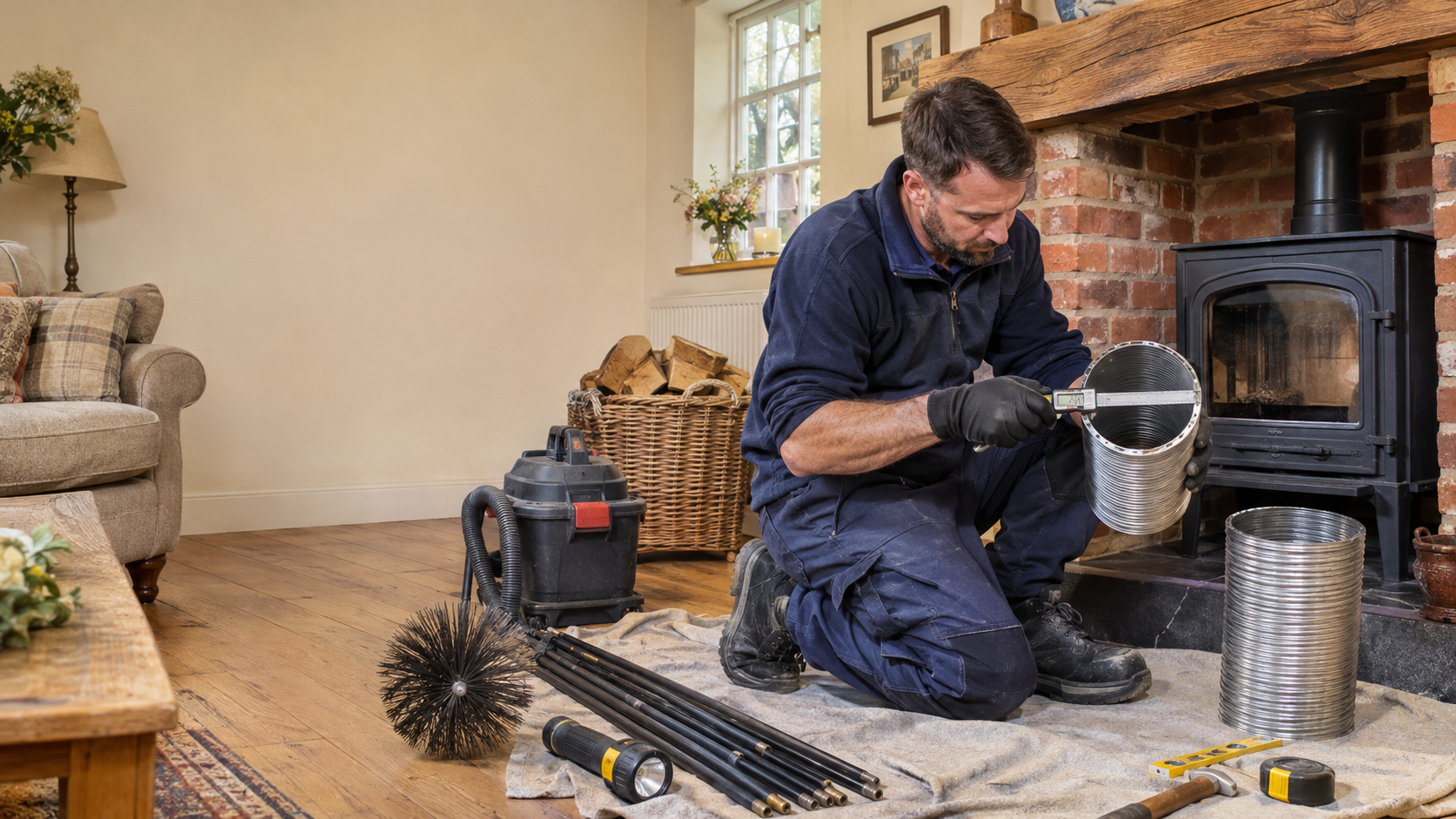
The existing chimney, flue liner, hearth, ventilation and surrounding building materials must also be assessed.
A professional installation survey helps determine whether the property can safely accommodate the chosen appliance.
In some cases, an older chimney may require a suitable flue liner or additional preparation before installation.
The work must comply with applicable building regulations and be appropriately certified or notified through the relevant building control process.
At Midlands Sweeps, we provide professional log burner installation services, including chimney preparation, flue liner installation and related checks.
For homeowners considering their first wood-burning stove, discussing the room’s heating requirements before purchasing an appliance can help avoid costly mistakes.
Frequently Asked Questions About Log Burner Sizes
What size log burner do I need for a 4m × 4m living room?
With a ceiling height of 2.4 metres, the room volume would be 38.4m³. Using the basic volume calculation, this suggests approximately 2.7kW for average insulation. A professional heat-loss assessment is needed before choosing a specific appliance.
Is a 5kW log burner too big for a small room?
It can be. A small, well-insulated room may require significantly less heat. Choosing an oversized stove can make the room uncomfortable and encourage inefficient operation.
Is a 4kW log burner enough for a living room?
A 4kW stove may be suitable for many moderately sized living rooms, depending on insulation and heat loss. Room dimensions and a professional assessment should guide the decision.
What size log burner do I need for an open-plan room?
Open-plan rooms need an assessment of the complete heated area, insulation, glazing and heat distribution. A simple room-volume calculation may not accurately represent the heating requirement.
Do I need a chimney liner for a new log burner?
Not every installation requires a new liner, but the existing chimney must be suitable for the chosen appliance. A professional assessment can determine whether a liner is needed.
Can I install a larger stove and just use less wood?
Stoves can operate across a range of outputs, but deliberately choosing an oversized appliance and running it at very low combustion rates can lead to inefficient burning. Choose a stove whose suitable operating range matches the room’s heating needs.
Find the Right Log Burner for Your Home With Midlands Sweeps
Choosing the right wood-burning stove is about finding the correct balance between room size, insulation, heating requirements and installation suitability.
A simple room-size calculator can provide a helpful starting point, but it cannot replace a proper assessment of your property’s heat loss.
Whether you’re considering a compact log burner for a cosy living room or a larger appliance for an open-plan space, professional advice can help you make an informed decision.
At Midlands Sweeps, we provide log burner installation, chimney sweeping, flue liner installation and related chimney services across Swadlincote, Derby, Burton on Trent, Ashby-de-la-Zouch and surrounding areas.
As a veteran-owned, fully insured business and registered member of the National Association of Chimney Sweeps, Midlands Sweeps focuses on careful workmanship and appropriate installation practices.
Planning to install a new wood-burning stove?
Contact Midlands Sweeps to discuss your living room, chimney and installation requirements.
Phone: +44 782 483 0604
Email: midlandsweeps@gmail.com
Website: www.midlandsweeps.com
Our Services: Log Burner Installation
Book an Appointment: Contact Midlands Sweeps
Midlands Sweeps — professional chimney and log burner services for your home.